
One transmission rebuilder’s published price table puts a used transmission at $1,200 to $3,400 installed, a local rebuild at $2,200 to $4,500, and a remanufactured unit at $2,400 to $7,000. Those ranges overlap more than most car owners expect, which is exactly why the decision is harder than “cheapest wins.”
When a gearbox fails on a car that is otherwise worth keeping, the owner is really making an investment decision with three variables: up-front cost, risk, and how much life the car has left. Looking at it that way makes the choice clearer.
The three options, defined plainly
A rebuilt transmission is your own unit, torn down by a local shop, with worn parts replaced. You keep your core and the shop’s warranty, which is often local.
A remanufactured transmission comes from a production facility. Every unit of a given model is rebuilt to the same specification, usually with updated parts, then tested and shipped with a nationwide warranty of one to three years. Companies like Jasper Engines & Transmissions built their business on that model.
A used transmission is pulled from a donor vehicle and sold after inspection, with little or no internal work. It is the cheapest of the three and carries the most uncertainty, because you are betting on the donor’s history.
That last sentence is where most of the advice online stops. It shouldn’t.
Where used JDM units change the math
“Used” covers a wide spread of quality. A gearbox from a high-mileage American salvage yard and one pulled from a lightly driven car in Japan are both “used,” yet they carry very different odds.
Japan’s inspection system, shaken, makes older cars progressively more expensive to keep registered, so many are retired with relatively low distance on them. That steady supply is what lets importers sell used JDM transmissions from Japan with recorded mileage well below what a domestic yard typically offers for the same Toyota, Honda, Nissan or Subaru application. Lower mileage does not erase risk, but it shifts the probability of getting a healthy unit in the buyer’s favor.
For a business owner running a work vehicle, or a household with one paid-off car, that shift is worth quantifying. Suppose a remanufactured automatic for a mid-size sedan runs $4,500 installed and a low-mileage used unit runs $2,200 installed. The used option has to fail before the car is retired, and fail in a way the warranty doesn’t cover, for the reman to come out ahead. On a twelve-year-old car with maybe four years of planned ownership left, that is a reasonable bet. On a three-year-old car you plan to drive for ten more years, it probably isn’t.
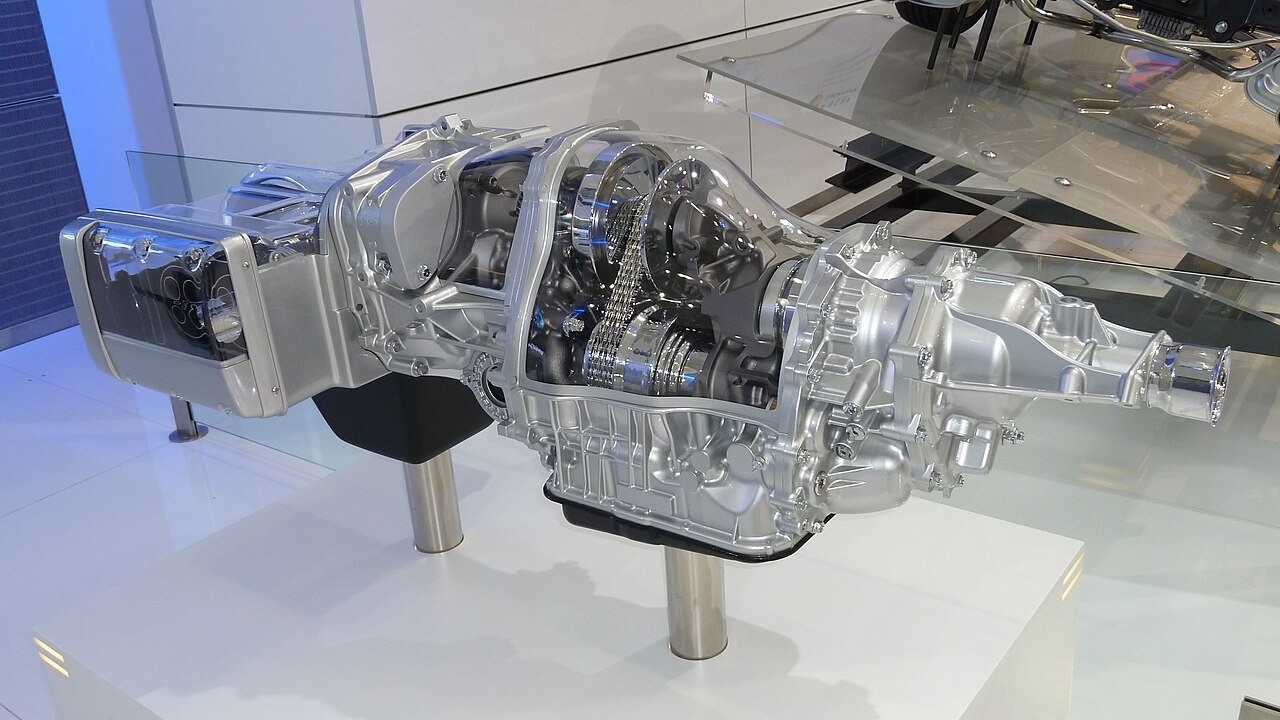
A cutaway Subaru Lineartronic CVT. Modern automatics and CVTs are complex enough that the warranty often matters more than the sticker price. Photo: Wikimedia Commons, public domain
Rebuilt, remanufactured or used transmission: what actually matters
Price is only one line. Here is how the three stack up on the factors that decide total cost of ownership.
- Warranty portability. Remanufactured units win clearly. If you drive across the country for work, a nationwide warranty has real value. Local rebuilds depend on the shop staying in business and you staying nearby. Used units usually carry a shorter warranty, often parts only, so read the terms on labor.
- Downtime. A local rebuild can take days to more than a week, since the shop has to tear down your unit first. Used and remanufactured units are swaps, so the car is often back the same week, depending on shipping.
- Control over specification. Only a rebuild lets you request upgrades, such as better friction material or a revised valve body. Reman units come at a fixed spec. Used units come as they are.
- Knowledge of history. Your own rebuilt unit has a history you know. Remanufactured cores are anonymous but fully refreshed. Used units are the least known, which is why the seller’s test data and mileage records carry so much weight.
Manual gearboxes shift the comparison again. They are mechanically simpler, cheaper to inspect, and less sensitive to how the previous owner treated the fluid, so a used manual from a clean donor is a lower-risk purchase than a used automatic or CVT.
A simple decision rule
Start with the remaining life of the car, not the transmission.
If the vehicle has many years ahead of it and you want predictability, a remanufactured unit or a good local rebuild is the safer spend. If the vehicle is older, the budget is tight, and the rest of the drivetrain is healthy, a low-mileage used unit from a seller who publishes mileage, offers a written warranty and confirms fitment by VIN is often the best return on the money.
Two checks apply either way. Confirm the exact transmission code, because Japanese and US model years and option packages do not always match, and a unit that “fits a 2010 Camry” may still have the wrong final drive or connector. And replace the cooler lines and flush the cooler on install. A fresh gearbox fed with debris from the old one is the quickest way to turn a smart purchase into a second repair bill.
The cheapest transmission is the one you only buy once. Sometimes that is the reman. Surprisingly often, for older Japanese cars, it is a well-documented used unit.